
News
How to Choose the Perfect Fishing Rod and Reel Combo
Sep
Part 1: Understanding Rods and Reels
Fishing is one of the world’s most beloved pastimes, but behind every successful angler is the perfect rod and reel combo. These two pieces of gear are the backbone of your setup, working together to determine not only how far and accurately you can cast, but also how effectively you can fight and land fish. For beginners, the world of rods and reels can feel overwhelming, filled with jargon like “medium-heavy power” or “7.1:1 gear ratio.” For seasoned anglers, fine-tuning these choices can mean the difference between frustration and mastery.
This section dives deep into understanding rods and reels: how they are built, what makes them unique, and how to pair them into a balanced combo that feels like an extension of your arm.
1. Why the Rod and Reel Combo Matters
At its core, fishing is about connection: the connection between you, your gear, and the fish. The rod transmits vibrations and provides leverage, while the reel manages your line and controls the battle once you hook a fish. Together, they are the heart of your fishing system.
Performance: The right combo improves casting distance, accuracy, and hook-setting power.
Comfort: A balanced rod and reel reduce fatigue during long fishing sessions.
Confidence: Knowing your gear is reliable allows you to focus on technique and enjoying the experience.
A mismatched or poorly chosen combo can make fishing unnecessarily difficult. For example, pairing a lightweight rod with a heavy reel creates imbalance, making the setup feel awkward in your hands. Similarly, a rod with too much flex and a reel with too little drag power might cost you a trophy fish.
2. Anatomy of a Fishing Rod
Understanding rods begins with their anatomy. Each part plays a role in casting, sensitivity, and fighting fish.
Rod Length
Short rods (5–6 feet): Provide accuracy and control in tight spaces like streams or under docks.
Medium rods (6.5–7 feet): The most versatile length, balancing distance and control.
Long rods (7.5–12 feet): Designed for long casts, often used in surf fishing or when targeting species in open water.
Longer rods cast farther but can be harder to maneuver, while shorter rods provide precision but limit casting distance.
Power (Rod Strength)
Power refers to the rod’s resistance to bending under pressure:
Ultralight: For small species like trout or panfish.
Light/Medium-Light: Great for finesse techniques and smaller freshwater species.
Medium: Versatile for bass, walleye, and general-purpose fishing.
Medium-Heavy to Heavy: Required for larger fish like pike, muskie, or saltwater species.
The power rating should match your target fish and line weight.
Action (Rod Flex)
Action describes how and where the rod bends when pressure is applied:
Fast Action: Bends mostly near the tip, providing sensitivity and quick hook-setting.
Moderate Action: Bends halfway down the rod, ideal for treble-hook lures and a balance of sensitivity and forgiveness.
Slow Action: Bends throughout the rod’s length, best for small fish and light baits.
Action influences how effectively energy transfers during casting and hook-sets.
Material
Graphite: Lightweight and sensitive, excellent for detecting subtle bites.
Fiberglass: Durable and flexible, forgiving for beginners or heavy applications.
Composite: A blend of both, offering sensitivity and toughness.
Modern anglers often choose graphite for sensitivity, but fiberglass still shines for crankbaits and heavy-duty scenarios.
Guides and Handles
Guides: The small rings along the rod distribute stress and guide the line. Quality ceramic or titanium guides reduce friction and prevent wear.
Handles: Cork provides comfort and grip in dry conditions, while EVA foam is durable and performs well when wet. Handle length also matters—longer handles give leverage for powerful casts, while shorter ones offer finesse and control.
3. Anatomy of a Fishing Reel
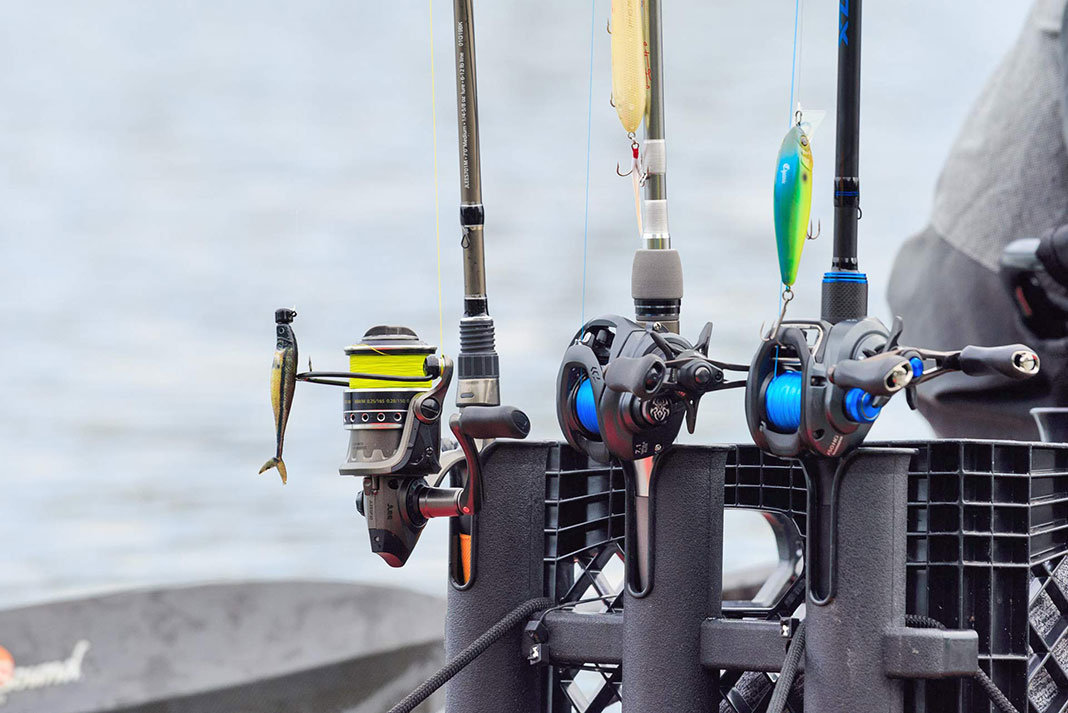
Just as rods vary widely, reels come in different styles, each designed for specific applications.
Spinning Reels
Best For: Beginners and versatile fishing.
Advantages: Easy to use, less prone to backlashes, excellent for light lines and small lures.
Limitations: Less line capacity and power compared to baitcasters for heavy-duty applications.
Baitcasting Reels
Best For: Experienced anglers and precision casting.
Advantages: Greater control, higher line capacity, and more power for larger fish.
Limitations: Steeper learning curve, prone to backlashes if not managed properly.
Spincast Reels
Best For: Absolute beginners.
Advantages: Push-button simplicity, tangle-resistant.
Limitations: Limited durability and performance, not suitable for larger fish.
Fly Reels
Best For: Fly fishing techniques.
Advantages: Designed for specific fly lines, smooth drag, and balance with fly rods.
Limitations: Limited application outside of fly fishing.
4. Reel Features to Understand
When choosing a reel, certain features are critical for performance.
Gear Ratio: Determines how quickly line is retrieved. A 7.1:1 ratio retrieves line faster than a 5.3:1 ratio. High-speed reels excel for fast-moving lures, while slower ratios provide more torque for deep cranking.
Drag System: Controls how much resistance the fish feels when pulling line. A smooth, reliable drag prevents line breakage and helps tire out fish.
Line Capacity: Important for targeting large fish or fishing in deep water.
Ball Bearings: More bearings generally mean smoother performance, but quality is more important than sheer number.
5. Matching Rod and Reel for Balance
A great combo is about harmony. The rod and reel must work together, not against each other.
Weight Matching: A medium-power rod pairs best with a medium-size reel. An ultralight reel on a heavy rod will feel awkward and unbalanced.
Line Rating: Both rod and reel should accommodate the same line strength range. For example, a rod rated for 8–12 lb line should be paired with a reel designed to handle similar line sizes.
Application-Specific Combos:
Light spinning combo for trout or panfish.
Medium spinning combo for bass or walleye.
Heavy baitcasting combo for muskie or saltwater species.
Balance not only affects casting efficiency but also reduces strain on your wrists and arms during long days of fishing.
6. Common Mistakes Beginners Make
When learning to choose a rod and reel, beginners often fall into predictable traps:
Choosing Gear Too Heavy: Thinking a stronger rod means better fishing. In reality, heavy rods are cumbersome and overkill for small fish.
Ignoring Action: Overlooking the importance of rod flex leads to poor casting and missed hook-sets.
Buying Cheap Combos: Budget gear often sacrifices durability and performance, leading to frustration.
Not Considering Environment: A reel perfect for freshwater may corrode quickly in saltwater.
Forgetting About Comfort: Grip, handle length, and weight distribution matter just as much as specs.
Avoiding these mistakes ensures smoother learning and better results from the start.
Conclusion of Part 1
Understanding the anatomy and function of rods and reels is the first step in mastering fishing gear. From rod length and power to reel type and drag systems, every detail influences performance. The goal is to build a balanced combo that feels natural in your hands, suits your target species, and adapts to your fishing environment.
With this foundation, you’re ready to move into Part 2, where we’ll explore how to choose the right combo for your specific fishing style—whether it’s freshwater, saltwater, fly fishing, or beyond.
Part 2: Choosing the Right Combo for Your Fishing Style
Now that you understand the anatomy of rods and reels, the next step is choosing the right combination that matches your fishing style, environment, and target species. Not every rod and reel combo is universal; the “perfect” choice depends on where you fish, what you fish for, and even how you like to fish.
This section provides a detailed guide to selecting combos for different scenarios, from freshwater ponds to roaring surf, from budget-friendly setups to premium investments.
1. Freshwater Fishing Combos
Freshwater fishing is where most anglers start, and versatility is key. Lakes, rivers, and ponds hold a variety of species—from panfish and trout to bass and pike.
Ideal Rod
Length: 6–7 feet
Power: Medium-light to medium
Action: Fast or moderate-fast for sensitivity and control
A 6’6” medium-power, fast-action rod is often called the “all-around freshwater rod” because it balances casting distance with accuracy and strength.
Ideal Reel
Type: Spinning reel for beginners and intermediate anglers; baitcasting reel for advanced anglers targeting bass.
Size: 2000–3000 for spinning reels (perfect for lines in the 6–12 lb range).
Gear Ratio: 6.2:1 to 7.1:1 for versatility across lures.
Recommended Combos
Beginner: 6’6” medium spinning rod + size 2500 spinning reel (spooled with 8 lb monofilament).
Bass Angler: 7’ medium-heavy baitcasting rod + low-profile baitcasting reel with 7.1:1 gear ratio (spooled with 12–15 lb fluorocarbon).
Trout Enthusiast: 6’ ultralight spinning rod + 1000 size reel (spooled with 4–6 lb line).
Freshwater combos should lean toward versatility. Unless you’re chasing trophy catfish or muskie, there’s rarely a need for heavy gear.
2. Saltwater Fishing Combos
Saltwater presents unique challenges: larger fish, harsher conditions, and corrosive salt. Combos need to be stronger and built with salt-resistant materials.
Inshore Fishing (flats, bays, piers)
Rod: 7’ medium-heavy spinning rod with corrosion-resistant guides.
Reel: 4000–5000 size spinning reel with sealed bearings.
Line: 15–20 lb braided line with fluorocarbon leader.
Offshore Fishing (deep sea, big game)
Rod: 6’–7’ heavy-power rod, strong backbone for fighting tuna, marlin, or grouper.
Reel: Large saltwater spinning or conventional reel (6000+ size).
Line: 40–80 lb braided line.
Saltwater reels should always feature sealed drags and anti-corrosion coatings. Never overlook maintenance—rinse gear with fresh water after each trip.
3. Fly Fishing Combos
Fly fishing is a different world, where casting isn’t about weight of lures but about the weight of the line. Balance is even more critical here.
Fly Rods
Weight Rating: Matches the line weight (e.g., 5-weight rod for 5-weight line).
Length: 8’6”–9’ for most freshwater trout and bass. Longer rods (10’–11’) are better for nymphing or larger rivers.
Fly Reels
Size: Matches the rod weight (5-weight rod pairs with 5-weight reel).
Drag: Smooth, adjustable drag for protecting light tippets.
Arbor: Large-arbor reels improve retrieval speed and reduce line memory.
Typical Setups
Trout: 9’ 5-weight rod + 5-weight reel + floating line.
Bass: 9’ 7-weight rod + 7-weight reel + weight-forward line.
Saltwater (Bonefish, Redfish): 9’ 8-weight rod + 8-weight reel + intermediate sinking line.
Fly combos are often sold as pre-matched kits, making it easier for beginners to get started without worrying about mismatched components.

4. Specialized Combos
Fishing is wonderfully diverse, and there are setups for very specific environments.
Ice Fishing Combos
Rod: Short rods (24–36 inches), ultralight to medium power.
Reel: Small spinning reels or inline reels designed for vertical jigging.
Line: 2–6 lb test for panfish, heavier for walleye or pike.
Surf Fishing Combos
Rod: Long rods (9–12 feet) for distance casting. Heavy power for throwing large baits into surf.
Reel: Large spinning reels (5000–8000 size) with strong drag.
Line: 20–30 lb braid with shock leaders.
Travel Combos
Rod: Telescopic or 4-piece rods for portability.
Reel: Compact spinning reels that can handle a wide range of conditions.
Perfect for anglers who want to pack light but still fish effectively.
These specialized setups are not for everyone, but they highlight how gear adapts to the environment.
5. Budget vs. Premium Options
Not every angler needs to spend hundreds of dollars to enjoy fishing. But knowing where to invest matters.
Budget Combos ($50–150)
Great for beginners or casual anglers.
Expect decent performance but limited durability.
Best suited for freshwater or occasional fishing.
Mid-Range Combos ($150–300)
Balanced in performance and price.
Often the sweet spot for serious hobbyists.
Durable enough for frequent trips, versatile across techniques.
Premium Combos ($300+)
High-quality materials like titanium guides, carbon blanks, and sealed drags.
Precision engineering, smoother performance, and long lifespan.
Best for competitive anglers, pros, or those targeting trophy species.
Tip: Spend more on reels than rods if you must prioritize. A good reel lasts longer and impacts performance more significantly.
6. Testing Gear Before You Buy
Buying a combo isn’t just about specs on paper—it’s about feel.
Balance Check: Mount the reel onto the rod and see where it balances. Ideally, the balance point should be just ahead of the reel seat.
Grip Comfort: Hold the rod as if you were fishing for hours. Is the handle comfortable?
Reel Smoothness: Turn the handle; it should feel smooth without grinding or wobbling.
Drag Test: Pull line from the reel; drag should release smoothly without jerking.
If buying online, read reviews and check brand reputation. Look for combos tested by real anglers in similar conditions to yours.
7. Caring for Your Rod and Reel Combo
Once you’ve found the perfect combo, maintenance is key to ensuring it lasts for years.
After Each Trip: Rinse with fresh water, especially after saltwater use.
Rod Care: Check guides for cracks that can fray your line. Store rods vertically or in cases to prevent warping.
Reel Care: Lightly oil moving parts, clean the spool, and loosen the drag during storage.
Line Care: Replace monofilament yearly, braid every couple of years, depending on wear.
Proper care protects your investment and ensures that your gear performs like new each season.
Conclusion of Part 2
Choosing the right fishing rod and reel combo isn’t about chasing the fanciest gear—it’s about matching the right tools to your fishing style, target species, and budget. From versatile freshwater setups to heavy-duty saltwater rigs, from fly fishing elegance to specialized ice rods, there’s a perfect combo for every angler.
The key lies in balance, comfort, and purpose. Once you find the combo that feels natural in your hands and suits your fishing environment, you’ll fish with greater confidence and success.
Part 3: Final Thoughts and Actionable Checklist
After exploring the details of rods, reels, and the countless ways they can be matched, it’s natural to feel both excited and a little overwhelmed. Fishing gear is like the tools of any craft: the deeper you go, the more possibilities you discover. But here’s the good news—choosing a rod and reel combo doesn’t have to be complicated. Once you focus on your personal fishing style, the waters you frequent, and your budget, the options narrow into a clear path.
Let’s close this guide with some practical wisdom, a quick-reference checklist, and tips to keep your fishing journey smooth and enjoyable.
1. The Golden Rules of Choosing Combos
When it comes to pairing rods and reels, a few universal principles hold true across all fishing environments:
Balance Is Everything
The rod and reel should feel like an extension of your arm. If the combo feels awkward or heavy, you’ll tire quickly and lose accuracy. Always test the balance point—your wrist should not strain when holding it.Match Power to Target Fish
Ultralight setups are amazing for panfish but useless against strong saltwater species. Always consider the strength of the fish you’re pursuing.Line Matters Too
Your rod and reel aren’t complete without the right line. Make sure your reel’s capacity and rod’s rating align with the line strength you plan to use.Durability Over Flash
A no-frills, well-built combo beats a flashy, low-quality one. Materials, guides, and reel construction matter more than color schemes.
2. Common Mistakes to Avoid
Even experienced anglers occasionally fall into traps when selecting combos. Here are the most common errors—and how to sidestep them:
Chasing Trends Instead of Needs
Don’t buy a setup just because it’s popular or recommended for a style of fishing you rarely do. Focus on your actual habits.Ignoring Comfort
If the handle feels rough, too short, or too thick, you won’t enjoy long hours on the water. Comfort is as critical as specs.Buying “Too Much Rod” Too Soon
Beginners often purchase heavy or advanced setups that are difficult to handle. Start simple, then upgrade as your skills evolve.Neglecting Maintenance
Even the best combo will fail if not cared for. Salt, dirt, and neglect are the true enemies of your gear.
3. Quick Checklist Before You Buy
Here’s a simple step-by-step process to guide your purchase:
Define Your Environment
Freshwater pond, river, or lake?
Saltwater inshore or offshore?
Specialized (fly fishing, surf, or ice)?
Identify Your Target Species
Small fish (panfish, trout)? → Light to ultralight combos.
Mid-sized (bass, walleye, redfish)? → Medium to medium-heavy.
Large/trophy (pike, tuna, marlin)? → Heavy-duty setups.
Choose Rod Specs
Length: Shorter for accuracy, longer for distance.
Power: Matches fish strength.
Action: Fast for sensitivity, slow for flexibility.

Select Reel Type and Size
Spinning for versatility and ease.
Baitcasting for accuracy and control.
Fly reel for specialized techniques.
Size according to line weight and target fish.
Check Balance and Comfort
Mount reel on rod and test balance.
Hold it as though fishing for hours.
Consider Budget
Start where you’re comfortable. Quality exists at every price point.
Upgrade gradually instead of overspending upfront.
4. Making the Most of Your Combo
Owning the right rod and reel combo is only the beginning. To maximize performance:
Practice Casting: A balanced setup becomes second nature when you train your muscle memory.
Switch Lines: Experiment with monofilament, fluorocarbon, and braided lines. Each changes how your combo behaves.
Upgrade Gradually: Replace components like line, lures, or even the reel before changing the entire combo.
Fish Often: Experience teaches you more than any guide. The more you fish, the better you’ll know what combo feels “perfect.”
5. Final Inspiration
Fishing is more than catching fish—it’s about the moments between casts, the calm of sunrise on the water, and the stories you’ll tell later. The right rod and reel combo doesn’t just improve your success rate; it deepens your connection with the sport.
Think of your combo as your fishing partner: reliable, tuned to your style, and always ready for the next adventure. Whether you’re pulling in your first bluegill or fighting a trophy tarpon offshore, the combo in your hands shapes the experience.
So take the time to choose wisely. Balance performance with comfort, ambition with budget, and always remember—your best combo is the one that makes you want to keep fishing.
Conclusion
Selecting the perfect fishing rod and reel combo is not about finding a universal “best,” but about discovering what fits you. By understanding rods, reels, and how they match different environments and species, you’ve already gained the knowledge most beginners lack.
Now, armed with a checklist and practical advice, you’re ready to make a confident choice. Treat your combo well, fish often, and upgrade when your passion calls for it.
The water is waiting—and with the right rod and reel combo, every cast brings you closer to your next great story.
Enjoy every moment on the water; prioritize safety, respect nature, and continually refine your gear and skills—over time you’ll craft a perfect, personalized fishing experience worth remembering for many seasons.
